Home Monticello Art Case Collectionmonticello Art Case Collection

 |
| West front of Monticello. Photo by Mary Porter. |
Westward hen Thomas Jefferson (1743–1826) retired from the presidency in 1809 and returned to Monticello to live year-circular for the first time since 1796, his domestic world was expansive and complex. His wife, Martha Wayles Skelton Jefferson (1748–1782), had been dead for near 20-7 years, but his oldest daughter Martha Jefferson Randolph (1772–1836), her husband, Thomas Mann Randolph Jr. (1768–1828), and their 11 children joined the Monticello household, as did Jefferson's sister Anna Marks (1755–1828), and, somewhen, a grandson-in-law, his grandmother, and iii keen-grandchildren. one
Monticello was famous for its hospitality and cuisine. The obligation to entertain the flow of visitors—both invited and unexpected—could exist overwhelming. Family letters indicate that the Jefferson household entertained a near abiding round of relatives, neighbors, friends, acquaintances, and even national and international celebrities. Martha Jefferson Randolph described a particularly busy week in late summer 1825:
I…invited the ii families to dinner, expecting 1 carriage full of ladies and peradventure 3 gentlemen behind say viii persons, there came two carriages full of ladies and children, and 4 gentlemen on horseback 12 persons, too four others unexpected which with your aunt Cary's family Fabricated 20 persons to dinner in the dining room and 11 children & boys in My sitting room 31 persons in all. two days afterward, Monday we had another invited party, and Thursday another. every mean solar day but one some person more than the family, and Saturday…another dinner party, 4 in the same week. 2
Monticello's dining room was the heart of conviviality in the house. An elegant neoclassical space, the dining room was an eighteen-foot cube with a skylight, Doric entablature featuring alternating rosettes and bucrania (ox skulls) in the metopes of the frieze, a large triple sash window overlooking the west lawn, and an adjoining semi-octagonal alcove called the tea room. 3 Pigment analysis recently ended past Susan Buck indicates that the first pigment on summit of the lime-washed plaster walls was chrome yellow. Chrome yellow—lead chromate—was capable of producing an intense yellow paint impossible to achieve with any other pigments. This extremely stylish and expensive pigment, first bachelor commercially in the Us in 1812, cost thirty-three times the cost of white lead pigment. 4
The dining room walls, painted Wedgwood bluish since 1936 on the ground of a misreading of evidence in the era before scientific paint analysis (Fig. 1), were repainted chrome yellowish in Feb 2010. At the same fourth dimension, Monticello'southward curators concluded a reevaluation of the furnishings in gild to ensure that the entire dining room reflected the latest inquiry. As a result, Monticello visitors at present see a brilliant infinite where architecture, fine and decorative arts, and Jefferson'south renowned labor-saving devices together conjure the ambient in which excellent food and free-flowing chat delighted his family'southward many guests (Fig. 2).
Recent reintroductions to the room include a French carpet and serving table. While living in Paris every bit America'due south minister to French republic from 1784 to 1789, Jefferson fabricated notes of bachelor types of carpets and their respective costs. It seems likely that he chose an Abbeville carpet, a French wool carpet with a velvety pile woven in strips like an English Wilton, instead of a much higher-priced Aubusson. five Working with carpet historian Sarah B. Sherrill and designer Ralph Harvard, Monticello's curators commissioned a floral carpeting with a scroll border based on French rug patterns of the late 1770s and early 1780s (Fig. 3). 6
 |
| Fig. 3: View showing floral carpeting with scroll border and serving table with carved bracket supports. On the serving tabular array are ceramic and silverish objects from the Monticello drove. The light-green beat out border pearlware, on loan from Colonial Williamsburg, represents the types of wares nigh commonly used for dining at the end of Jefferson's life. The adjoining tea room could function as an overflow dining space, but also served as a sitting room and space for taking tea. Photograph by Philip Beaurline. |
When Jefferson returned from Paris in 1789, eighty-half-dozen crates of belongings followed him home. A list of the contents of the crates prepared by a professional person packer, or emballeur, named Grevin enumerates the effects Jefferson purchased for his Paris residence. Much of Jefferson's French furniture has been on view at Monticello for decades but one item, a three-piece marble serving table, has never been deemed for. 7 Grevin described the three component parts of the object as "deux portent qui portait le marbre de la salle á manger" and, in another instance, "un marbre." 8 Sometimes fastened to the dining room walls of French houses, these marble topped tables supported past carved marble or wooden legs or brackets (tabular array d'applique) could be used during dinner service and for brandish of family silver or other prized possessions. 9 Monticello curators commissioned a faux-marble serving table with carved bracket supports from Harrison Higgins of Richmond, Virginia, based on a flow prototype past Georges Jacob that sold at Sotheby's, Paris in 2006. The brackets of the new piece contain volutes with rosettes and have paw feet (run across effigy iii).
One dinner topic Jefferson favored, according to young Bostonian George Ticknor who visited in 1815, was "the antiquities of his native state." 10 Ane of Jefferson's favorite Virginia antiquities was certainly Natural Bridge, the historic land germination located some ninety miles southwest of Monticello that he purchased in 1774. A catalogue of Jefferson's art collection that he compiled around 1815 reveals that clustered together on his dining room walls, nearly probable on either side of the pedimented triple sash window facing the west lawn, were prints and paintings affording views of Natural Bridge, the confluence of the Potomac and Shenandoah Rivers at Harpers' Ferry, Niagara Falls from both the American and Canadian sides, New Orleans, and Coalbrookdale Bridge (Figs. 4, 5). xi The latter, a feat of human engineering and a marvel of the Industrial Revolution, was the world'south first cast iron bridge, built over the Severn River Gorge most Coalbrookdale in the English Midlands in 1779. Jefferson no doubt arranged the constellation of pictures to make the about of the comparisons, celebrating both the wonders of nature and of human being achievement. Betwixt them the window framed a view of Jefferson's advisedly constructed mount-top flower walk around his beautifully leveled west lawn.
 |
| Left: Fig. four: W wall of the dining room with pedimented window and works of art. Photograph by Sequoia Design. Right: Fig. 5: J. C. Stadler (active early on nineteenth century), after William Roberts, Natural Bridge, 1808. Colored aquatint. Jefferson'southward views of Natural Span and Harper'due south Ferry were paintings by William Roberts, given to him by the artist during his presidency. This aquatint was fabricated after Jefferson's now unlocated painting. Photograph by Edward Owen. |
Jefferson ensured a relaxed dining environs past reducing the formality of the dinner service and thereby the number of enslaved servants needed in the dining room. Using several labor-saving innovations, butler Burwell Colbert could oversee dinner assisted past only a few waiters.
| |  |
| | Fig. vi: Monticello'due south revolving serving door. Photograph by Ballad Highsmith. |
The showtime of these innovations, a revolving door with shelves—likely inspired by those used for communication with the outside globe in cloistered Catholic monasteries and convents—was located at 1 end of an alcove on the east side of the dining room (Fig. 6). When Colbert rotated it, the door whisked platters of nutrient or dirty dishes in or out of the room from or to the passageway outside, thus eliminating a need for straight interaction between the delivery and serving of food.
An constant Monticello mystery has been the appearance and whereabouts of Jefferson's sideboard, which a family document says stood in the alcove. A recently discovered Jefferson packing list provided valuable new evidence for the advent and origin of the sideboard. It revealed that a sideboard was probable among the pieces of furniture Jefferson purchased from Thomas Burling in 1791 after arriving in New York to serve as George Washington'south Secretary of State. A sideboard was sold by Jefferson's family unit at the dispersal sale following his death in 1826. Using equally a model a mahogany with mahogany veneer and tulip poplar sideboard by Burling of the right date and dimensions, now in a individual collection, Monticello curators deputed a reproduction sideboard from Richmond cabinetmaker Harrison Higgins, which now stands in the alcove (Fig. vii).
 |
| Fig. 7: View of the dining room showing the reproduction sideboard standing in the alcove. The revolving serving door is at the cease of apse, to the left of the sideboard. Photograph by Philip Beaurline. A newly acquired sideboard provides insight into the function of this narrow infinite. It suggests that the alcove served not only to set off and highlight this large and handsome piece of furniture, just also as a backstage area from which Burwell Colbert mediated between the elite earth of the diners and the quotidian globe of the enslaved cooks leaving dishes of nutrient on the other side of the revolving serving door. |
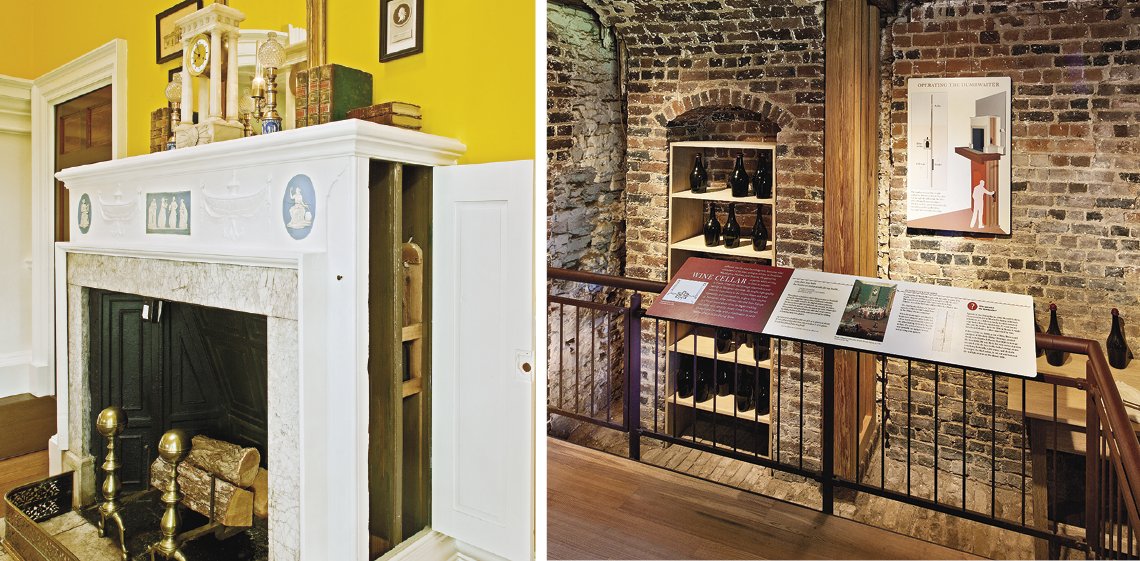 |
| Left: Fig. 8: View of the Dining Room fireplace showing one side of the wine dumbwaiter. Photo past Philip Beaurline. Right: Fig. nine:Lower level of wine dumbwaiter in Monticello'due south restored vino cellar. Photo by Philip Beaurline. |
The second labor-saving devices were wine dumbwaiters, small pulley-driven elevators curtained on either side of the fireplace mantel (Fig. viii). These transported wine bottles from the wine cellar beneath, so no slave was required to bring the wine into the room (Fig. 9). Additionally, diners used pieces of furniture besides called dumbwaiters, which were tiers of galleried shelves placed between chairs, to articulate and reset their ain places betwixt courses (come across figure viii). Jefferson had experienced these conveniences, uncommon in America, at the modest informal dinner parties he favored in Paris. 12 All three devices only reduced the number of slaves nowadays in the dining room. Behind the scenes, however, a sizeable cast of enslaved workers, and the white women of the household, labored to make the proceedings await effortless.
During his v-twelvemonth stay in Paris every bit American minister (1784–1789), Jefferson learned to enjoy French nutrient and wine. After his render, Monticello's enslaved cooks were always trained as French chefs. A slave named James Hemings had accompanied Jefferson to Paris and studied cooking and pastrymaking in that location. Hemings returned to Virginia with Jefferson and received his freedom later on teaching his brother Peter the art of French cooking. As President, Jefferson employed a French chef, Etienne Lemaire, and ensured that 2 enslaved women from Monticello, Edith Fossett and Frances Hern, learned to cook from him.
 |
| Fig. ten: Monticello'south restored kitchen. Photograph by Philip Beaurline. |
Fossett and Hern were the master chefs at Monticello during Jefferson'due south retirement years. They and their assistants prepared the complex meals for many diners using the stew stoves and open hearth in Monticello's kitchen forth with the elaborate copper batterie de cuisine Jefferson shipped home from Paris (Fig. 10). To convey nutrient to the revolving serving door, the cooks and their helpers transported information technology from the kitchen down a covered all-weather passage, which continued the kitchen and other piece of work spaces, to the main block of the house. A basement room beneath the dining room served as a final warming and prep kitchen—known as an office in French houses—where the food was sauced and transferred to argent and ceramic serving dishes before being carried upstairs.
Surviving family unit recipe manuscripts tell the states that Jefferson enjoyed braised meats like boeuf boulli or boeuf á la daube, with quantities of vegetables, many of them, such as blanched sea kale, grown in his big experimental garden. xiii Recipes indicate that the family unit and their guests ate desserts like oeufs á la neige—snowfall eggs—or meringue in a bed of custard. Wine was served after the meal, in the English fashion, and included vintages from many of Jefferson's favored French estates, including Château Lafite and Château Yquem.
 |
| Fig. eleven: Figures of (l–r) Priscilla Hemmings, Martha Jefferson Randolph, Burwell Colbert, and Israel Gillette, part of Crossroads: Domestic Work at Monticello, the new permanent installation located in the cellar level of Monticello. Photo by Philip Beaurline. |
Jefferson's daughter Martha Randolph coordinated the many details of domestic direction with enslaved butler Burwell Colbert. Regretting her ain lack of preparation for her life equally a plantation mistress, Randolph required her six daughters and oldest granddaughter to learn the necessary skills. By the time they were teenagers, they shared household responsibilities with their mother for a month at a time on a rotating footing. As housekeepers, the Randolph women descended the stairs to the cellar level of the house to consult with the cooks and plan menus, and to lock and unlock cellars containing foodstuffs, household supplies, and tabular array wares. Managing the ware room, or nutrient storage space, entailed keeping it stocked and organized, maintaining current knowledge of what was in that location, and distributing daily ingredients to the cooks. The room's contents included saccharide, tea, coffee, chocolate, and spices acquired from merchants in Richmond and raisins, Parmesan cheese, almonds, anchovies, Dijon mustard, olive oil, and "maccaroni," Jefferson'due south word for pasta, obtained from abroad. Martha Randolph described the long hours required to run the household, "I have literally not one tranquillity hour from 5 in the forenoon my usual hr of rising, till x at dark, when nosotros generally retire." xiv
Under Martha Randolph'due south direction, Burwell Colbert, who likewise carried the keys to locked spaces, oversaw all domestic work, upstairs and downwardly. Downstairs, the central cellar space was a crossroads of activity. Here, enslaved domestic workers, Jefferson family members, slaves accompanying Monticello visitors, wagoners delivering supplies, and others crossed paths equally they went nigh their daily tasks. Cooks Edith Fossett and Frances Hern and their administration made frequent trips through the Passage to the Water ice Business firm and dorsum. Housemaids carried water, laundry, and other supplies upstairs and brought soiled linen and waste water down. Teenage house boys, like State of israel Gillette, carried firewood up and ashes down. Jefferson himself reportedly came downwardly to the kitchen every eight days to air current the clock.
 |
| Aerial of Monticello Mount from the southwest. Photograph past Leonard Phillips. |
A new installation in the central cellar space—Crossroads: Domestic Work at Monticello—gives gimmicky visitors a sense of the constant buzz of domestic activity that in one case pervaded Monticello, while life-sized figures introduce them to some of the people who worked to sustain the Jefferson household: enslaved butler Burwell Colbert; Jefferson'southward girl Martha Jefferson Randolph; Priscilla Hemmings, enslaved nurse to Jefferson's grandchildren; Israel Gillette, enslaved house servant; and enslaved house maid Betty Brown, shown sewing with ten-year-old Harriet Hemings, daughter of enslaved Sally Hemings (Fig. xi). Each effigy is accompanied by archaeologically recovered objects representing items they may have worn or used. The exhibition contains four interactive components so that visitors tin can experience operating a model of the wine dumbwaiter, ringing and hearing the service bells activated in the parlor and Jefferson's bedroom, ironing with a heavy iron, and unlocking a locked door.
The Thomas Jefferson Foundation owns and operates Monticello. Call 434.984.9880 or visit world wide web.monticello.org for information and to make reservations.
ane. At the finish of Jefferson's life, the Monticello household also included Nicholas Trist (1800–1874), husband of Jefferson's granddaughter Virginia Randolph (1801–1882); Trist's grandmother, Elizabeth House Trist (ca. 1751–1828), an old friend of Jefferson's with whose family he had lodged in Philadelphia during the Continental Congresses of 1782–1784; 2 children of deceased granddaughter Anne Cary Randolph Bankhead (1791–1826); and the infant daughter of Nicholas and Virginia Trist.
two. Martha Jefferson Randolph to Ellen Randolph Coolidge, September 18, 1825. Ellen Wayles Randolph Coolidge correspondence, University of Virginia, Charlottesville, Va.
three. The dining room entablature was inspired by Plate v, page 30, of the 1766 edition of Roland Fréart de Chambray, Parallèle de 50'compages antique avec la modern (offset published Paris, 1650). Jefferson's copy with the inscription "Dining Room" higher up the plate survives at the Library of Congress.
4. Meet Rutherford J. Gettens and George L. Stout, Painting Materials: A Short Encyclopedia (New York: Dover Publications, 1966).
5. "Table of Costs for Carpeting and Calico," 1784–89, Thomas Jefferson papers, Library of Congress.
6. Meet Sarah B. Sherrill, Carpets and Rugs of Europe and America (New York: Abbeville Printing, 1996), plates 93 and 95.
7. Post-obit Jefferson'south decease on July iv, 1826, the majority of the Monticello furnishings were sold to pay his debts. Since the Thomas Jefferson Foundation purchased Monticello in 1923, many original Jefferson objects accept been reacquired. The great bulk of the effects on view in the Monticello house belonged to Jefferson and were used past him and his family unit. For the Monticello collections, run across Susan R. Stein, The Worlds of Thomas Jefferson at Monticello (New York: Abrams, 1993).
eight. 2 supports for the dining room marble and a piece of marble.
ix. For a representative example, encounter Mark Girouard, Life in the French Country House (New York: Alfred A. Knopf, 2000), p. 143. Also see Le mobilier domestique (Paris: Imprimerie Nationale, 1992), vol. I, 286–89.
10. For Ticknor'southward account see Merrill D. Peterson, ed. Visitors to Monticello (Charlottesville: Academy Press of Virginia, 1989), 61–66.
11. "Catalogue of Paintings &c. at Monticello," ca. 1815, Thomas Jefferson papers, University of Virginia, Charlottesville, Va.
12. See Charles Montgomery, American Piece of furniture: The Federal Period (New York: Viking, 1966) 393–94.
13. For more on food and dining at Monticello, as well every bit Monticello recipes adapted for the modern kitchen, see Damon Lee Fowler, ed., Dining at Monticello: In Good Gustatory modality and Abundance (Charlottesville, Va.: Thomas Jefferson Foundation, 2005).
14. Martha Jefferson Randolph to Ellen Randolph Coolidge, September one, 1825, Ellen Wayles Randolph Coolidge correspondence, Academy of Virginia, Charlottesville, Va.
Elizabeth V. Chew is curator at Monticello, Charlottesville, Virginia.
This article was originally published in the Fall/Winter 2010 issue of Antiques & Fine Fine art magazine, a fully digitized version of which is available at www.afamag.com . AFAis affiliated with Incollect.com .
Source: https://www.incollect.com/articles/new-perspectives-on-domestic-life-at-monticello
0 Response to "Home Monticello Art Case Collectionmonticello Art Case Collection"
Enregistrer un commentaire