Think the clothes you’re buying are sustainable? Think again
Advertisement
Obsessions
Recall the clothes you're buying are sustainable? Think again
As much as nosotros consumers feel guilty most the environmental and social costs of our wardrobes, most of united states of america have no thought what "sustainable products" entail. We don't know our own carbon footprints, much less that of a creamy Mongolian cashmere jumper or pair of calf-leather ankle boots.
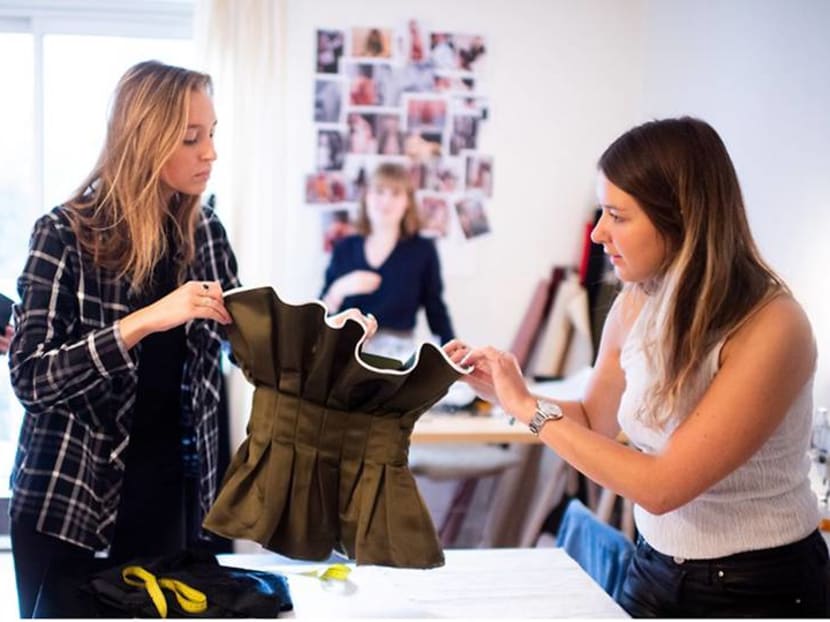
Fashion designers Elena Feit and Alexia Hanemian piece of work on a cosmos for their brand The Ethiquette in Paris, on September 23, 2019. (Photo: AFP/Martin Agency)
The breathless electronic mail was all too familiar. Information technology was from Levi'south, the company I purchase most of my denim from, telling me about a new product: Its "most sustainable jeans ever". Made of "high quality recycled denim" and hemp, these jeans were "positive touch" and "negative waste", the copywriters pledged.
There are some phrases so well-worn, nosotros become numb to their meaning. For me, "sustainable fashion" is one of those phrases. It is a term now so ubiquitous in PR and marketing, so liberally applied to whatever brand that uses organic cotton fiber or articles its appurtenances locally, that its fundamental definition has become obscured.
I am not alone.
"I barely even know what the word 'sustainable' ways any more," said the designer Stella McCartney, who has been speaking out confronting the industry's tape on the surroundings and man rights since the 1990s, equally she unveiled her spring/summer 2022 collection final month.
"The majority of people who say they're doing a sustainable thing, if you inquire one question, it will pretty much fall down at the first hurdle . . . Information technology'south a scrap tiring to run across people'southward overuse of these terms and really not have whatsoever substance to back information technology up."

READ> The fashion manufacture overproduces, just what happens to all the unsold wearing apparel?
During the past four years, the number of wearing apparel and accessories described equally "sustainable" has quadrupled amidst online retailers in the US and Uk, according to Edited, a London-based retail analytics company. Corresponding terms such every bit "vegan", "witting" and "eco" take also seen their usage multiply, the company said.
Where there is progress, brands are quick to shout about it. Organic and recycled fibres, once a rarity, tin now be institute in designer collections and in H&M. Yarn spun from recycled ocean plastic has become a major ingredient in everything from Adidas track pants to Prada nylon backpacks. Loftier-end labels such as Balenciaga and Burberry now tout non only the luxuriousness of their materials, just also whether they encounter certain environmental certifications. More importantly, companies over the by decade accept begun to quantify the affect across their full supply chain and take strides to reduce it.
Merely at that place's a trouble. Non simply is fashion not sustainable, it is becoming less so every moment. A report published by the Global Fashion Agenda in Copenhagen and the Boston Consulting Group last year revealed that the apparel and footwear industries' progress on everything from carbon reduction to ensuring living wages for workers was 30 per cent slower in 2022 than the year earlier. The sector is also growing so apace that its impact on the planet is actually worsening. The book of apparel and footwear beingness produced is forecast to increase by 81 per cent to 102 1000000 tons by 2030, according to the report.
It isn't merely fast fashion at mistake. Even Gucci parent Kering, which has one of the most advanced and transparent ecology policies in the luxury sector, has struggled to reduce its footprint because its brands are growing then chop-chop.
And yet the skilful news keeps coming: In a deluge of emails promising products that are "carbon neutral", "negative waste" or even "positive touch" – as if the making of a new garment could really be a skilful thing for the planet. No wonder many of us are dislocated.
"There is this vast array of icons and language and terminology, all of which feed a dynamic where customers don't question a purchase, information technology reinforces a purchase," said Alex Weller, European marketing director at Patagonia, a US outdoor clothing visitor whose public mission is "to save our home planet". The company donates one per cent of gross sales to environmental projects and doesn't employ the word "sustainable" to describe itself or any of its products.
"It's a agglomeration of coded language so that we retrieve, yeah I'm comfortable with that, I tin can buy that," Weller continued. "Versus trying to assistance the customer make a smart decision."
"We've gotten to a place where citizens know sustainability is something they should care about, simply they are not informed plenty to know what information technology means to be sustainable." – Maxine Bedat
READ> Could sharing and renting clothes be the new mode norm in Singapore?
TURNING OF THE TIDE
As recently every bit a decade ago, few fashion brands wanted to be described every bit "sustainable".
When Yael Aflalo launched Reformation, a Los Angeles-based label known for its flirty, floral-impress dresses, in 2009, she didn't talk virtually how many of her garments were made from upcycled vintage or deadstock fabrics because her publicist told her information technology was "not going to resonate with fashion consumers", she told me in a 2022 interview.
"But we had seen the alter in the automotive manufacture, seen the alter in the food manufacture," the founder and former chief executive said. "And [we knew] fashion was going to exist next."
Today, many of u.s.a. are starting to feel pretty guilty about the environmental and social costs of our wardrobes. Surveys of US and United kingdom shoppers repeatedly show that we would prefer to purchase more "sustainable products", and would even pay slightly more for them. Only most of u.s. accept no idea what that entails. Nosotros don't know our own carbon footprints, much less that of a flossy Mongolian cashmere jumper or pair of calf-leather ankle boots nosotros might be lusting afterward.
Those who make an endeavour to be informed will inevitably encounter masses of imitation and contradictory data, as I did while reporting this story. Twenty-plus-folio reports from world-leading consultancies are full of dubious statistics almost manner'southward share of carbon emissions and h2o pollution. And whether materials such as organic cotton fiber or recycled nylon are truly better for the environment than their non-organic and non-recycled counterparts is nonetheless hotly debated within the scientific community.
"Nosotros've gotten to a place where citizens know sustainability is something they should care about, merely they are non informed plenty to know what it means to exist sustainable," said Maxine Bedat, founder of New York-based New Standard Institute, a research and advancement group focused on the relationship between fashion and climatic change.

She would know; she used to apply the label to her ain apparel brand, Zady. Founded in 2022 as an due east-commerce site that championed small batch, organic, and transparently made wear and lifestyle goods, information technology before long launched its own label, which was historic for being among the first to trace the organic cotton of its T-shirts or the wool of its jumpers from farm to finish – and and so make that information bachelor to consumers. Such transparency remains rare.
It wasn't easy.
"I remember thinking, huh, how practice you Google search this?" Bedat recalls of building the supply chain for Zady. "I idea, if we could find a ranch that is doing things the right manner, and see who they ship their production to, that would be a showtime. Just fifty-fifty once we constitute our rancher in Oregon, at the beginning she didn't desire to connect us with the people she worked with.
"It very much became this investigation of what all the steps were, who was doing the steps in the supply chain in the right manner, and what did it hateful to do things in the right mode."
THE Effects OF GLOBALISATION
It wasn't ever so complicated. Apparel and footwear brands used to industry their own goods; they endemic their factories, and some spun their own yarns. But decades of globalisation and trade policy have encouraged brands to outsource product, and with it they have lost oversight and ownership of their supply chains.
Mapping today'due south supply bondage is an arduous journey that can take years. Companies such as H&M utilize more than a k factories across the world, many of which subcontract that work out to other factories brands take no cognition of. Often factory owners are unwilling to reveal who their fabric suppliers are, who in plow do not want to reveal the secrets of their fibre supply, for fright of being undercut.
Persuading 3rd-party suppliers to become greener – to power their machines with solar ability, say, or to begin sourcing and working with lower-impact materials that could require new sources and equipment – requires persistence, patience and investment.
"Part of the challenge is that 'sustainability' means 10 unlike things to ten different people – microplastics, air quality, recyclability, biodiversity." – Tim Dark-brown
"What the media have got wrong, is that they want [sustainability] now, even though at that place'due south no realistic mode of getting it now," Jonathan Anderson, creative director of LVMH-owned Loewe and JW Anderson, and a longtime collaborator with Uniqlo, tells me.
He began implementing "massive production changes" across the labels 4-and-a-half years ago – making wear out of recycled plastic bottles, finding less toxic ways of galvanising hardware, working on denims with Uniqlo that require 80 per cent less h2o – but has kept relatively quiet about them.
"At that place's a lot of people who love to use a moment like this, a PR moment, to say we're doing this [sustainable] collection," he said. "That'due south not sustainable. That's just going with the public zeitgeist.
"It'south a 10-year strategy to do right," he added. "And your whole team has to want to exercise it."
In 2018, Bedat close downwards Zady. Last twelvemonth she founded the New Standard Institute as a resource centre for brands, journalists and citizens to educate themselves about fashion's ecology and social costs, and what it will take for the industry "to be within planetary boundaries in which people and the planet can thrive", she said.
Brands have been leading the give-and-take on sustainability, creating a glut of misinformation, she explains. Until journalists and citizens are better educated and demand greater transparency and regulation, brands will be able to say whatever they want, and legislators volition prioritise other issues.
"Clothing will always have an bear on. What we demand is for brands to speak most what they're doing to reduce impact and be honest and transparent near how far they are going and where they need to go.
"No company can be perfect," she continued. "Merely don't telephone call something sustainable if it isn't."
"I barely fifty-fifty know what the word 'sustainable' means any more… It's a bit tiring to come across people'due south overuse of these terms and really not take whatsoever substance to back it up." – Stella McCartney
THE PANDEMIC ERA
In some ways, the pandemic has been skilful for the sustainability motility. Global vesture and footwear sales are expected to fall 27 to 30 per cent this year, according to McKinsey analysts, and brands have cutting back on production.
At fashion weeks, concepts and methods that were once the exclusive domain of young, fringe designers – using deadstock cloth, for case, or cutting up and refashioning terminal flavour's unsold garments into something new – are now existence adopted by large mainstream brands such as Louis Vuitton and Maison Margiela.
"Carbon-neutral" shows, in which brands starting time the carbon emissions they tin't eliminate by donating to wood restoration projects, for example, are becoming standard. Executives are better informed about their company's sustainability policies than they used to be. Many, such as Timberland owner VF Corp and Chanel, take set aggressive targets to reduce and outset their carbon output. In September the latter committed Us$35 million (South$46.vii million) to install solar panels on the roofs of depression-income families in California – which will generate enough renewable electricity to power the company's entire operations in North America.
"When I started at the Sustainable Apparel Coalition, the number of sustainable apparel manner professionals could fit in one room," said its one-time chief executive Jason Kibbey, who now leads Higg Co, which helps brands and retailers evaluate the environmental touch on of the materials they use. "At present at that place are thousands."
But it has as well put more than price force per unit area on mass-market brands that are thinking harder about the bottom line.
"When I've spoken with brands that are positioned with lower-priced products, I haven't heard them push dorsum and say that they don't want to be more sustainable," said Brian Ehrig, a retail and sustainability specialist at US consulting firm Kearney.
"I've heard them push back and say it's going to make my production more expensive. Right now, with the global recession we're in, trying to become consumers to pay more for a garment or a pair of shoes seems very unlikely."
"There's a lot of people who beloved to use a moment like this, a PR moment, to say nosotros're doing this [sustainable] collection. That's not sustainable. That's only going with the public zeitgeist." – JW Anderson
CARBON Equally A UNIFYING METRIC
In Apr, Allbirds, the unicorn footwear start-up whose merino-wool, sugarcane-soled trainers have become ubiquitous in Silicon Valley, began labelling every 1 of its items with its carbon footprint. The company's average product emits 7.6kg CO2e, which is roughly the equivalent of driving 30km in a car, or running five loads of laundry in the dryer.
"Our hope is that carbon becomes a unifying metric and north star for the fashion industry, and all other entities and organisations," said Tim Brown, Allbirds' co-founder and a erstwhile captain of New Zealand's football squad.
Carbon isn't the be-all end-all metric for measuring a product'due south environmental impact, in the same way that calories don't fully capture a food's nutritional benefits. "But it can assist you make healthier choices," argued Chocolate-brown.
"Part of the challenge is that 'sustainability' means 10 different things to x different people – microplastics, air quality, recyclability, biodiversity," he continued. "Some of those factors have competing incentives, and so it can be confusing in terms of what is the right matter to do. What we're doing is coming to the conclusion that all things affair, but all line upward to carbon."
Retailers are likewise starting time to earmark products that meet certain environmental criteria – and stop carrying those that don't. "[German language e-tailer] Zalando is a adept example. They're basically going to get rid of companies not engaged in sustainability," said Higg Co's Kibbey. "We're going to see more than and more platforms do the same, using loftier-quality data to make up one's mind what products are going to be sold to most consumers. That volition shape the manufacture apace."
In Baronial, luxury department store group Selfridges expanded a labelling system as part of its Project Earth initiative that highlights products that are organic, wood-friendly or vegan. Under the hood, these products are rigorously vetted for certifications and accreditations, Daniella Vega, group sustainability managing director of Selfridges, said. The retailer has also given brands targets to ensure that the ix almost environmentally impactful materials used in their products come from "certified, sustainable sources" by 2025, she added. Luxury due east-tailers Net-a-Porter and MatchesFashion take introduced like labels.
As a shopper, I'm aware that I am part of the problem. I've stopped buying virgin leather, and I try to find whatever jumper or jacket I'1000 in pursuit of on a second-hand site earlier I purchase it new. And nonetheless I place at least one order on a luxury e-commerce site every month. I reason that I'k buying well-made products that I can eventually pass on or re-sell. Just still, I buy more than I need.
How practise nosotros break out of these habits of consumption? Patagonia's Weller likens it to "reprogramming".
"I grew upwardly in the 90s, which is probably the period of time when a lot of usa were clean-cut to consume," he said. "There was for my peers a moment of reckoning, of realisation that this dizzying consumption was ridiculous. Of class everybody instinctively knows that. You but have to block cognitive dissonance for a second to know that this is completely excessive."
When I fess up about my own shopping habits, Weller's reply is measured: "Information technology is an iterative journey for everybody. You demand to truly engage and invest in everything yous ain and take responsibility for information technology. Not just as a transaction and item, but as a useful, meaningful possession that you're going to take care of. That's a mindset shift. That requires people to recall differently most stuff."
Words to live, and shop, past.
HOW TO REDUCE THE Ecology FOOTPRINT OF YOUR WARDROBE
1. Buy less and article of clothing your clothes for longer. This is the simplest and most impactful matter you can practice.
2. Buy second-hand. Local charity shops are your best selection. Consignment platforms such every bit The RealReal, Vestiaire Commonage and eBay are good destinations for pre-endemic luxury products, although they require packaging and send.
3. Research earlier you buy new. Websites such as GoodOnYou.eco charge per unit brands based on environmental impact, labour weather and animal welfare. Read up on brands' sustainability policies on their websites, and check for certifications such as B Corp and Bluesign. Avoid synthetic fabrics derived from fossil fuels, such as acrylic and polyester, which cannot be recycled at scale.
iv. Wash your clothes in cold h2o, and less frequently.
5. Think nigh what volition happen to a product at the terminate of its life bike. Is it valuable enough that someone would purchase information technology 2d-paw? Is the fabric recyclable? Repair broken zippers or missing buttons on items before donation – damaged items volition automatically head to a landfill.
"You need to truly engage and invest in everything you own and accept responsibility for it. Non merely as a transaction and item, but as a useful, meaningful possession that yous're going to take care of. That's a mindset shift. That requires people to think differently about stuff." – Alex Weller
By Lauren Indvik © 2022 The Financial Times
READ> Second-hand luxury: The shift to vintage and pre-loved is at present in full swing

Recent Searches
Trending Topics
Source: https://cnalifestyle.channelnewsasia.com/obsessions/think-the-clothes-you-are-buying-are-sustainable-think-again-246881
0 Response to "Think the clothes you’re buying are sustainable? Think again"
Enregistrer un commentaire